
When Life Hurts: Finding Jesus in the Silence of Suffering
If you are anything like me, spy movies are comfort food. James Bond, secret briefcases, coded warnings, and the strange thrill of watching people walk around like they are carrying the world in a locked container.
There is one classic moment in that genre that always gets my brain going. Someone shows up in public with a super secret briefcase, and you instantly know what it means. Top secret documents. Money. Gold bars. The kind of “this is bigger than you” secrecy that makes the scene feel cinematic.
But here is the thought experiment that shifts the mood from silly to serious:
What if somebody sat down with you for lunch and handed you a “top secret briefcase,” then said, “Open it. Inside is the why of the most painful thing you have ever been through.” Would you open it?
Most of us say yes, instantly. Not because we are masochists, but because the question feels like oxygen. When life hurts, we reach for explanations. We ask, “Why me?” “Why this moment?” “Why did it happen?” “Why them?” “Why God?” We repeat it until it starts to sound like the only prayer we know.
And yet, there is a tension here. Even if you got the answer, would it actually heal?
Explanations don’t heal wounds. Presence does.
The speaker in my own head knows how this story goes. We imagine that if someone could just provide the full explanation, we would finally breathe again. But real life does not cooperate with that logic.
Consider something simple like breaking a leg. You do not sit in the emergency room demanding a lecture on gravity and anatomy. You want an ER. You want help. You want morphine. You want someone to put the pieces back together.
Knowing the science of why you fell is not the point when pain is roaring. The need is immediate and human: someone to respond, someone to stay, someone to walk you through the brokenness.
That is the irony of what follows. The story we are going to live inside is the book of Job, and it is basically one long confrontation with the desire to know why. Job spends chapter after chapter asking, demanding, seeking an explanation.
And what he gets is not a tidy answer. What he gets is something deeper: an encounter with God’s presence in suffering.
The “problem of evil” shows up in a very personal way
There is a classic question in philosophy often called the problem of evil. It tries to hold two things together: if God is all good, why does evil exist? Why does suffering exist? Why does cruelty coexist with goodness?
We race to explain. We want the internal logic of the universe to make sense.
Job’s life becomes the stage where that question collides with raw reality. In a nutshell: he loses everything. Not gradually, not with a warning label, but in a crushing sequence that leaves him with no “footnotes” to soften the blow.
One messenger arrives first with bad news. His animals are stolen and farmhands are killed. While that messenger is still speaking, another arrives: fire has fallen from heaven and burned the sheep. Then another: raiders steal camels and kill servants. Then a wind sweeps in and destroys the house where his children were feasting.
It is a horrific progression. If you read Job for the first time, you feel that instinctive human reaction: enough. A normal person reaches for the same conclusion. This cannot keep happening.
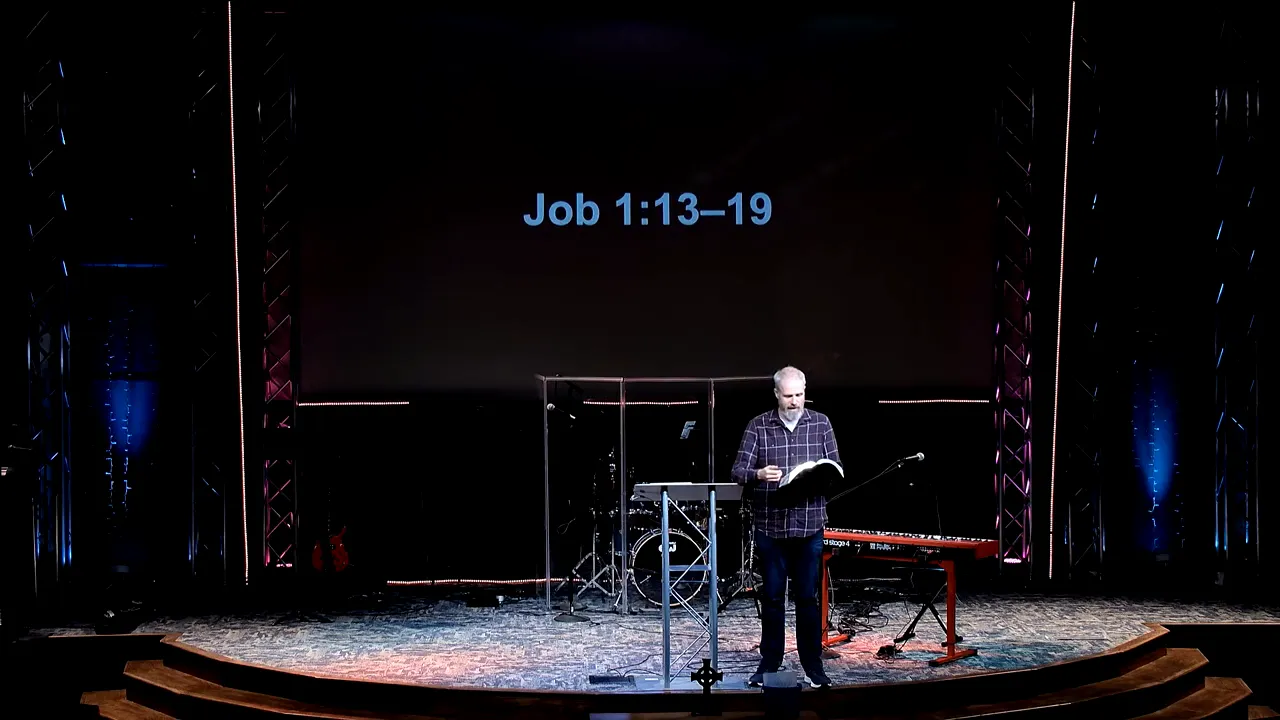
Job loses wealth and status. He loses livestock, which in that world is not just “stuff,” it is survival. He loses his family. And eventually, his health collapses too.
And through it all, he does not receive a clear explanation.
The problem of evil does not get solved in Job the way we might want. Instead, something about the nature of God is revealed. When we ask why loudly enough, sometimes we encounter a deafening silence.
So here is the moment to bookmark: silence in your pain.
We imagine that if we could just get an answer, we would be okay. But the reality is more complicated. What we need is not only information. We need an encounter. We need someone.
When Jesus suffers, he also cries out: “Why have you forsaken me?”
This is where the story turns from Job to Jesus, and the emotional connection gets even sharper.
There is a moment on the cross that echoes Job’s experience: Jesus cries out, “Why have you forsaken me?”
That line has challenged thinkers for centuries. Theologians ask: if Jesus knows what is happening, why does he speak like this? If he is God, why does he cry out in a way that sounds like abandonment?
One helpful way to understand it is to remember the mystery of the incarnation. Jesus is both fully God and fully human. That means God does not only watch suffering from a distance. God enters it.
In that moment, there is no dramatic “answer from heaven.” No angel arriving with a solution. No dove landing to interrupt the grief. Just silence. Just the weight of pain.
In other words, God sits with the thing we sit with: the eerie silence in the middle of suffering.
That matters because it refutes one of our most common fears. We think God is far off, like a star or a moon. We think God cannot really understand our daily reality. Jesus breaks that idea wide open.
We have a Jesus who sweat. A Jesus who bled. A Jesus who cried. A Jesus who was murdered. In Christian terms, God does not experience only the clean parts of human life.
And now, in the midst of the cross, God experiences the silence too.
That is what makes Jesus different from a distant philosopher or a cosmic explanation machine. Job asks why. Jesus asks why. But in both cases, God meets humanity inside the unanswered space.
Hebrews 4: the High Priest who understands
The book of Hebrews uses the language of priesthood to say something very practical: we do not have a high priest who cannot empathize with our weakness.
Jesus has been tempted in every way, yet did not sin. He has been through pain. He has been through silence. He has been present when “why” gets no immediate response.
He is not a distant observer. Isaiah describes the Messiah as a “man of sorrows, acquainted with grief.” Not grief floating separately above us, not pity from a cloud, but grief understood from the inside.
And here is the key point: Jesus does not come to give a lecture that explains every detail of your pain. He comes to walk with you through it.
That is what “Emmanuel” means: God with us. God is with us even in the deepest, darkest, scariest moments of life.
What C.S. Lewis learned after grief: “It is not the locked door”
When people talk about the problem of pain and evil, they sometimes sound like they are trying to win an argument. But grief has a way of turning arguments into something more honest.
C.S. Lewis wrote two different works that connect to this theme. One deals more academically with the problem of evil. Another is “grief observed,” written after the death of his wife.
In grief observed, Lewis describes what happens when he lays his questions before God. He says he gets no answer. But it is not the kind of silence that feels like rejection.
“It is not the locked door. It is more like a silent, certainly not uncompassionate gaze… Peace, child, you don’t understand.”
That line captures something many of us discover the hard way. Asking why is not wrong. It is human. We ask it all the time. We pray it with tears. We ask it with anger. We ask it with bargaining and exhaustion.
But often we do not receive satisfying answers. Job did not. Jesus did not receive a rescue from the silence in the moment he cried out.
Your job loss. Your marriage. Your choices. Your kids. Your pain. They might not come with an explanation that makes everything neat.
And even if we somehow knew the why, it might not heal what is broken inside us. Lewis suggests that if the answer arrived too quickly, it would not have mended the heart. What needed to happen was not merely understanding, but walking through pain not alone.
The performance trap: hiding our whys and polishing our faith
There is another issue that creeps in when suffering continues without answers: we begin to perform.
Some churches have an unspoken rule that you are not supposed to have a bad day. You smile. You show up dressed right. You pray the right kind of prayers. You never let your anger show. You filter your doubts. You hide your scars.
In the speaker’s words, this can become a “performance trap.” We think God only wants the saintly version of us. We think honesty will be a liability.
But Job did not use churchy language. He spoke raw and everyday. Jesus did too, from the cross. The Bible never treats suffering as a reason to stop being honest.
So what would it look like to stop editing yourself for God?
Not to pretend your questions do not exist. Not to force a positive spin. But to bring the truth of your pain into the presence of God and say something like:
- “God, I do not know why, but I need your presence.”
- “I need your peace. I need healing, mercy, grace.”
- “I need you in the middle of what I am going through.”
That is not faithlessness. That is faith speaking without makeup.
Palm Sunday to Resurrection Sunday: the who breaks the silence
This message sits right in the season of Holy Week. Palm Sunday opens the story of what happened next. The world watches suffering unfold. The disciples watch their hope get buried. And then Resurrection Sunday arrives.
In the Christian calendar, this is when the silence is broken.
But it is important to say this clearly: the resurrection is not merely an answer that explains why all the pain of the world exists.
It is the announcement of who God is and who Jesus is.
Job’s questions were real, but they did not become the final destination. The final destination is relationship. The gospel does not say, “Here are the answers to every why.” It says, “Here is the One who walks with you, suffers with you, and defeats death.”
That is why the message shifts from “Job is the why” to “Jesus is the answer.” Not an answer that removes your pain instantly, but an answer that carries your pain and sustains your hope.
Life isn’t fair, but God is faithful
Job shows us life is not fair. We should not expect fairness as a guarantee. There is no “such thing as fair” in the way we want it, at least not in this broken world.
But Jesus shows us something sturdier: even when life is cruel, God remains faithful.
That is why it is not the goal of faith to gather and compare who has the best explanation. Faith is not a secret society of people who know all the whys of suffering.
People gather to meet the Jesus who shows up in the worst moments and makes the presence of God real.
Community matters: you were not meant to suffer alone
One of the most practical takeaways from Job and Jesus is that suffering is not supposed to isolate us.
We gather for a reason. We gather so there is a family to process pain with. We gather so there are people who will pray for us. We gather so others point us toward Jesus when we are too tired to find our own way.
When the pain is heavy, community becomes a kind of mercy. It is not a cure-all explanation. It is care in motion.
If you are going through something right now, community may not remove the question mark from your mind. But it can keep you from living in the question mark by yourself.
A simple practice for this week: be a friend to someone asking “why”
There is also a way to take this beyond personal reflection and into love.
If you know someone who is stuck in unanswered questions, do not respond with clichés like “Just move on” or “Just get better.” Those phrases are often too light for the weight someone is carrying.
Instead, be steady. Be present. Be a friend.
And if you want to connect that friendship to hope, the invitation is simple: invite someone to Easter.
Easter is meant to be a place where people can bring their doubts, their whys, and their questions. It is not about forcing performance. It is about offering an encounter with God.
Because what breaks the silence is not only understanding. It is the voice of the resurrection, the shout of who Jesus is.
So the question becomes: who are you following?
When life hurts, the human reflex is to chase answers. Ask why. Demand explanation. Try to solve the riddle.
But the invitation of Job and Jesus is to answer a different question. Not “Why?” as the final destination, but “Who?”
Who walks with you in the deep dark scary moments?
In the Christian faith, that who is Jesus.
And when you follow Him, you are not promised life will always be fair. You are promised that you will not face suffering alone. God’s presence meets you in the silence. And the resurrection shows that love wins, even when the answers feel delayed.