
Making the Future Kingdom Visible Through Kindness
It has been a heavy stretch lately.
There are seasons when grief seems to come in waves. You lose someone you love, then another funeral comes, then another burden lands in your lap, and before long your chest feels tight from carrying not only your own pain but the pain of other people too.
That is part of life in a church family. When people share their fears, grief, uncertainty, and prayer requests, you carry those things with them. Not in exactly the same way they do, of course, but you still carry them. And sometimes the weight of all of it settles on you before you even realize how heavy it has become.
I had one of those moments recently sitting in my truck in a parking lot. I was praying through a long list of hard things people were facing, and I just felt it. That lump in the chest. That emotional pressure that makes you wonder whether something is wrong physically or whether your heart is just worn down by sorrow and concern.
Then a text came through.
Nothing dramatic. No long speech. Just a simple message from a friend: I’m praying for you. You’ve got this.
That was it.
And somehow that tiny message, which probably took only seconds to send, landed with enormous force. I read it several times. I’ve gone back to it since. The person who sent it may not have thought much about it afterward, but it mattered deeply to me in that moment.
That is what kindness does.
It often costs very little in money, but it can carry tremendous meaning. A text. A note. A kind word. A moment of prayer. A batch of muffins. A simple act of service. These things can become signs of the kingdom of God in ordinary life.
That is what I want to talk about here: how small acts of encouragement make the future kingdom visible right now.
The messages that matter most are rarely the ones being sold to us
As I sat in that parking lot, there was a giant digital billboard nearby cycling through ad after ad. Cars. Insurance. Real estate. The usual parade of things somebody desperately wanted me to notice.
Those messages cost money. A lot of money, probably. Somebody designed them, paid to place them, paid to rotate them, paid to keep them in front of me.
And yet none of those expensive messages touched me the way one free text message did.
That contrast is hard to ignore.
We live in a world full of messaging. Constant noise. Constant advertising. Constant persuasion. Everyone wants our attention. Everyone wants a click, a purchase, a reaction, a vote, a share, a subscription.
But some of the most important messages in life are not attached to a financial transaction at all. They are attached to love, presence, prayer, and encouragement.
Those are the messages that steady people.
Those are the messages that pull somebody through a hard afternoon.
Those are the messages that remind a person they are not drifting through this world alone.
And for Christians, that kind of encouragement is not optional. It is part of our calling.
We are living in the in-between time
One of the great tensions of the Christian life is that we live in between two world-changing realities.
- Jesus has already risen.
- Jesus has not yet returned.
We are post-resurrection, but we are still waiting for the full renewal of all things. We live with resurrection hope, but we still live in a world where funerals happen, injustice persists, people suffer, and grief remains painfully real.
That in-between space can do strange things to us.
Some people become passive. They treat the present like a waiting room. They assume the main task is simply to hold on until Jesus comes back.
Others throw themselves into every possible problem in the world because they feel the pain of injustice and want to do something meaningful now.
Most of us probably live somewhere in the middle. We are trying to pay bills, raise kids, make it through another week, and keep our faith intact while the world feels unstable.
The danger is that waiting for the kingdom can turn into ignoring the present.
If all we do is stare at the horizon, we may miss what God has placed right in front of us. We may become so preoccupied with the future that we stop paying attention to the people, needs, and opportunities around us today.
That is why Paul’s teaching in 1 Thessalonians 5 is so helpful. He gives a vision for how to live faithfully in the meantime.
Paul’s answer to end-times anxiety
The Thessalonian Christians wanted what many people still want now: a date.
They wanted details. A timeline. A chart. A clue. Something they could put on the calendar. We are not that different. Human beings love the idea that the future can be managed if only we can decode it.
Paul refuses to play that game.
He tells them the day of the Lord will come unexpectedly, like a thief in the night. He also compares it to labor pains, something both anticipated and sudden. In other words, the exact timing is not theirs to master.
But then he shifts the conversation in a surprising direction.
He does not say, “Here is the secret date.”
He says, in effect, you do not need a date. You need to remember who you are.
You are children of the light.
You are not in darkness.
You are not meant to live panicked, confused, or spiritually asleep.
This is such an important correction for people of faith. We often think what we need is more information. More signs. More predictions. More data points. But Paul points us to identity, not speculation.
That is still the issue for us today.
Many of us would rather have a prophetic spreadsheet than a deeply rooted sense of belonging in Christ. We would like certainty about the calendar. God offers us confidence in his love.
Paul’s message is that if you know Jesus, you are not meant to live in terror of his return. The return of Christ is not a threat hanging over the heads of God’s people. It is a homecoming.
God is not a cosmic hall monitor
A lot of people grew up with a picture of God that made faith feel exhausting.
Maybe you were taught, directly or indirectly, that God was basically waiting for you to fail. Like a cosmic hall monitor with a clipboard. Every mistake goes in the bad column. Every wrong move is noticed. Every failure confirms that you are disappointing him again.
That picture of God is hard to shake.
But it is not the picture Paul gives in 1 Thessalonians 5.
Paul says God chose to save us through our Lord Jesus Christ, not to pour out wrath on us. Christ died for us so that whether we live or die, we belong with him.
That is family language.
That is identity language.
That is grace language.
As we mature in Christ, many of us come to see God less as an official trying to catch us messing up and more as a loving Father who is forming us, teaching us, correcting us, encouraging us, and making us more like Jesus.
Yes, God is holy. Yes, sin matters. Yes, obedience matters. But the posture of God toward his children is not petty suspicion. It is redeeming love.
If your identity is in Christ, then your life is not defined by fear of being caught. It is defined by the mercy that welcomed you into the family of God in the first place.
The stunningly practical thing Paul says to do
Here is what really gets me about this passage.
Paul is talking about one of the biggest realities in all of human history: the return of Christ. This is not a side issue. This is cosmic. World-altering. Ultimate.
So how does he tell the church to respond?
Not by building bunkers.
Not by stockpiling fear.
Not by obsessing over secret codes.
He says: encourage each other and build each other up.
That is almost offensively simple.
And yet it is deeply challenging.
Because Paul ties the hope of Christ’s return to the way we treat other people right now. He connects future kingdom hope with present kingdom behavior.
If we really believe Jesus is coming, then our lives should begin to reflect the values of his kingdom today.
That means faith, love, sobriety of mind, hope, and encouragement. It means treating neighbors, coworkers, classmates, friends, family members, and fellow believers in ways that make the kingdom a little more visible.
That is not flashy. But it is faithful.
Becoming living billboards for the kingdom
I keep coming back to that billboard image.
Not because Christians should be loud or obnoxious or always trying to sell people something. Quite the opposite. We live in a culture already overloaded with self-promotion.
But there is a sense in which our lives broadcast a message.
People are reading us all the time.
They notice whether we are anxious or steady, harsh or gracious, cynical or hopeful, selfish or generous. They notice whether our faith makes us more loving or just more argumentative.
So the question is not whether we are communicating something. We are. The question is what message our lives are sending.
Can our neighborhoods, workplaces, schools, and friendships see something of the future kingdom in the way we live now?
Can people glimpse the character of Jesus through our encouragement, patience, compassion, and kindness?
That is what it means to become a living billboard for the kingdom of God. Not a polished advertisement. A faithful witness.
Pointing people toward the finish line
One of my favorite pictures of this comes from marathon volunteers.
I have never run a marathon, and I am very comfortable saying that I do not intend to start now. I run to the kitchen sometimes. That is about it.
But I love the image of the volunteers stationed along the route. Some hand out water. Some cheer people on. Some simply point the way so runners do not drift down the wrong street.
That is a lot like the church.
People are moving through life tired, distracted, wounded, confused, and sometimes ready to quit. Our task is not to become the finish line ourselves. Our task is to point the way toward Jesus.
Sometimes that looks like reminding someone not to give up.
Sometimes it means offering truth gently to someone who is wandering.
Sometimes it is simple presence during grief.
Sometimes it is practical help for someone who is overwhelmed.
Sometimes it is one text message sent at exactly the right time.
The church is called to say, in a hundred different ways, “Keep going. Christ is ahead. There is hope. You are not alone.”
Two kinds of people when the sirens sound
Living in Oklahoma gives you some memorable illustrations.
When the tornado sirens go off, there are basically two kinds of people. There is the person who has no clue what is happening, wanders outside, and stares at the sky like this is all new information. Then there is the person who has been tracking the radar for a week, has three televisions on, has the flashlight ready, and has already cleaned out the storm shelter.
Paul uses similar categories in 1 Thessalonians 5.
There are people caught unprepared in darkness, and there are people who know what is coming and live in the light.
The kingdom of God is coming. Absolutely, certainly, and finally. History is not random. Jesus is not absent forever. Evil does not get the last word.
So the question is what kind of people we are becoming right now.
Are we preparing for that future by living according to its values now?
Or are we still operating by the instincts of fear, selfishness, greed, and survival?
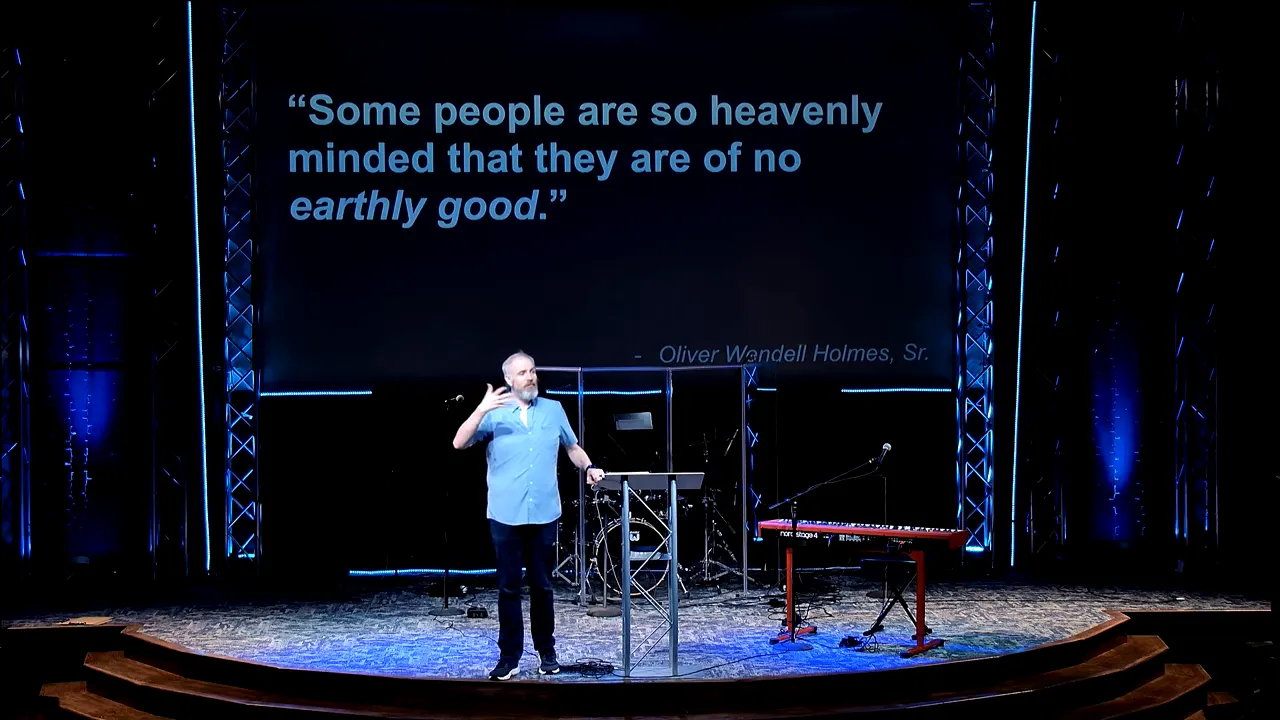
Read the Lord’s Prayer carefully and you can feel the answer pressing in: Your kingdom come, your will be done, on earth as it is in heaven.
If that is truly our prayer, then our lives should begin to reflect heaven’s values on earth.
The future is not escape. It is renewal.
Christian hope is bigger than evacuation.
It is not merely about getting out of here. It is about God making all things new.
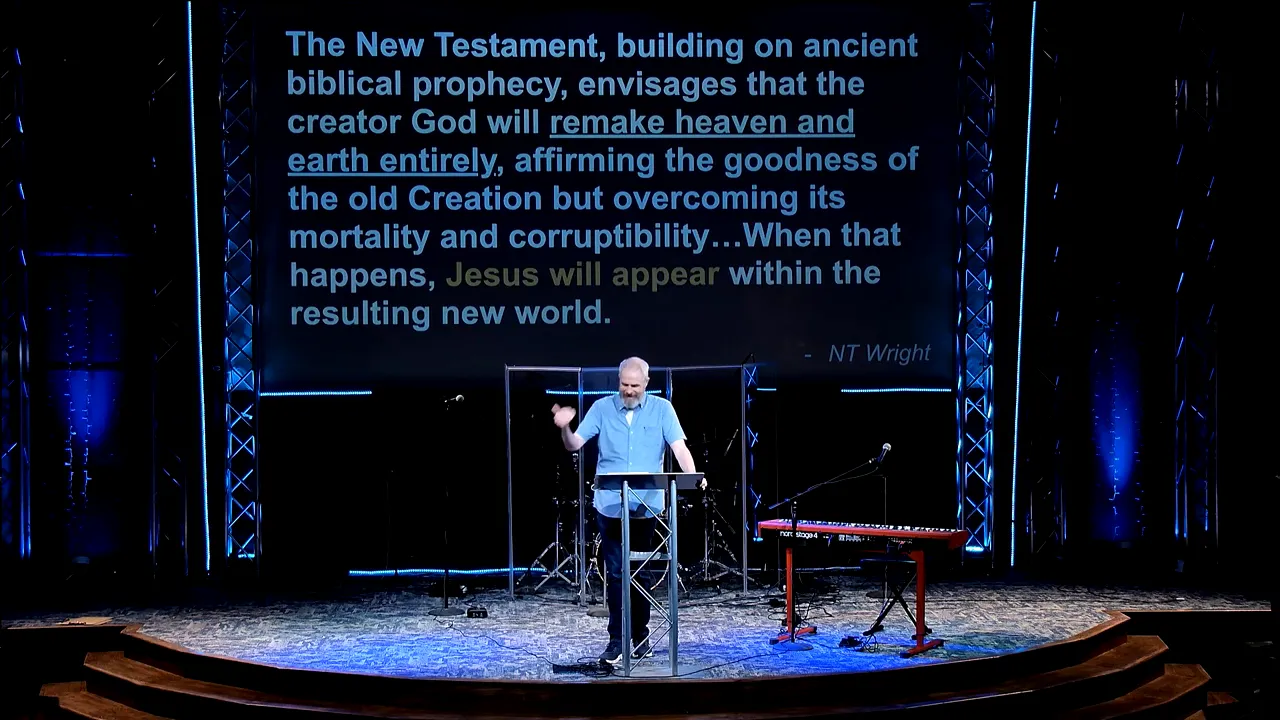
N.T. Wright puts it well when he describes the New Testament vision as the Creator remaking heaven and earth entirely, affirming the goodness of creation while overcoming its mortality and corruption.
That matters.
It means Jesus is not coming back simply to inspect the wreckage and shrug. He is coming to renew, restore, and recreate. Scripture ends with the breathtaking vision of a new heaven and a new earth.
That future gives enormous encouragement in the present.
When grief feels unbearable, when injustice seems entrenched, when the world feels driven by greed and cruelty, Christian hope says this is not the final version of reality.
God is not finished.
Jesus will remake what is broken.
And because that future is coming, we begin to practice for it now.
That means living Beatitudes-shaped lives. It means taking the “one another” commands of the New Testament seriously. It means becoming less obsessed with self and more concerned with serving others. It means making Christ more visible and ourselves less central.
Kindness is small only to the person who doesn’t need it
One of the easiest mistakes to make is to assume our acts of encouragement are too small to matter.
That is rarely true.
The text that steadied me did not cost anything. But it mattered.
A handwritten card can matter.
A quick email can matter.
A thoughtful conversation can matter.
A plate of cookies or a pan of muffins can matter.
Offering a practical skill to help someone can matter.
What feels ordinary to you may feel like mercy to someone else.
And every person has something they can offer.
- If you are a writer, write the note.
- If you are a texter, send the message.
- If you are good with words, speak encouragement.
- If you bake, bake.
- If you build, repair, organize, or fix things, use that skill.
- If you have time, give time.
- If you know how to pray, then pray and tell people you are praying.
The point is not the method. The point is love expressed in action.
Our time, talent, and treasure can all become instruments of encouragement. In fact, time may be the costliest gift of all because it is the one thing we cannot manufacture more of.
What encouragement looks like in real life
If you want a practical way to live this out, keep it simple. Ask one question:
Who around me might be barely holding on right now?
Then do one concrete thing.
Here are a few ways this can take shape:
- Send a short message to someone carrying grief or stress.
- Tell a friend specifically what you appreciate about them.
- Pray for someone and follow up to let them know.
- Take food to a family in a hard season.
- Offer help with a practical need.
- Give a word of hope to someone who feels forgotten.
- Remind a struggling believer of their identity in Christ.
That last one matters more than we often realize.
Sometimes people do not need more analysis. They need to be reminded who they are. They need to hear that they are not abandoned. Not unseen. Not disqualified. Not beyond grace.
They need help stepping back into the light.
Be encouraged, and become an encourager
There is a beautiful rhythm in the Christian life: we receive encouragement, and then we become people who give it away.
Someone strengthens us, and that strength overflows to somebody else.
Someone reminds us of hope, and then we become a reminder of hope in another person’s life.
That is how the kingdom becomes visible in the present. Not only through sermons and songs and official ministry moments, but through ordinary believers living with unusual kindness.
The future kingdom is coming. Jesus will return. God will make all things new.
Until then, we do not sit around twiddling our thumbs. We do not bury ourselves in fear. We do not spend all our energy trying to crack a prophetic code.
We live in the light.
We remember who we are.
We encourage one another.
We point people toward Jesus.
And sometimes, by the grace of God, that looks as small and as powerful as sending a text at just the right moment.
All across our city and all across this world, there are people carrying more than they can manage alone. People who are grieving, doubting, afraid, exhausted, or hanging on by a thread.
You may be the person God uses to steady them.
You may be the one who helps make the future kingdom visible through one act of kindness.
So encourage someone.
Build someone up.
Point someone toward the light.
That is holy work.
Small Steps Toward Peace
Sometimes kindness is hardest right when our hearts feel tight. If encouragement starts to feel out of reach, it can help to begin with inner healing—especially around anger, frustration, or resentment.
You can explore a practical, faith-informed approach here: forgiveness.
When bitterness loosens its grip, it becomes easier to send the kind text, offer the steady presence, and “build each other up” in the everyday moments that make the future kingdom visible.